WEBINAR - Marine Litter in the Eastern Caribbean
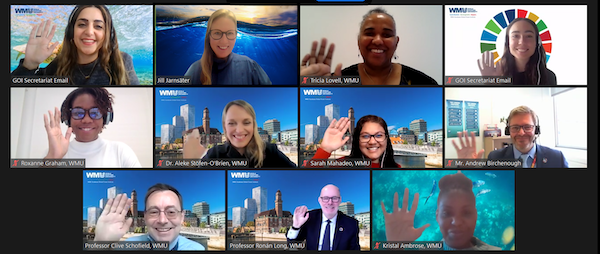
As part of the International Maritime Organization’s (IMO) Ocean Group Webinar Series, on 10 March, the World Maritime University (WMU)-Sasakawa Global Ocean Institute welcomed the international community to a public webinar, "No Space for Rubbish: Research Approaches to Reduce Pressures of Marine Litter in the Eastern Caribbean Region," that focused on research of The Nippon Foundation-WMU Closing the Circle Programme; Marine Debris, Sargassum and Marine Spatial Planning (MSP).
In his welcoming remarks, Mr. Andrew Birchenough, Technical Officer at the IMO’s Office for the London Convention/Protocol and Ocean Affairs, Marine Environment Division, noted that knowledge sharing and collaboration on various marine issues are core elements in reaching successful outcomes. He also expressed gratitude for the IMO Webinar Series which serves as an excellent forum to disseminate research conducted by academic institutions such as WMU.
Professor Ronán Long, Director of the WMU-Sasakawa Global Ocean Institute, made opening remarks and thanked the IMO, The Nippon Foundation, and the Governments of Sweden, Canada and Germany for their invaluable support to the Institute. He highlighted the various research programmes at the WMU-Sasakawa Global Ocean Institute and the significant progress made to date, including the important contribution of WMU Associate Research Officer, Dr Aleke Stöfen-O’Brien, to the Second World Ocean Assessment serving as co-convenor and author of Chapter 12 which deals with marine debris and dumping.
The presentations that followed focused on the importance of the health of marine ecosystems and the ocean environment that are threatened by marine debris in many forms and from many sources. Dr. Stöfen-O’Brien, Principal Investigator for the Closing the Circle project, presented the objectives and work plan highlighting the work undertaken to date including a range of peer-reviewed articles, workshops, a webinar series, and engagement in international processes under the UN General Assembly, IOC UNESCO and the IMO. Dr Stöfen-O'Brien presented a key publication of the research team which found that marine litter research in the Small Island Developing States (SIDS) in the Eastern Caribbean is subject to parachute science. Published in Marine Pollution Bulletin, the paper concluded that a significant amount of research undertaken on marine litter in the SIDS is done by researchers from developed countries without meaningful engagement of local researchers or organizations. This ultimately has consequences for the effectiveness of proposed measures and Dr Stöfen-O'Brien proposed recommendations on how to address the issue.
Presenting her experiences and lessons learnt regarding assessing marine debris management on an inter-regional scale, WMU PhD candidate, Roxanne Graham, discussed the usefulness of inter-regional collaboration such as the collaboration between the North-east Atlantic and Wider Caribbean Region via the OSPAR Convention and Cartagena Convention respectively. She highlighted the importance of coherence in regional policy and where regions can improve in their planning, as well as the existing benefits in North-South, South-South and Triangular Cooperations. Ms Graham noted that although there are opportunities in inter-regional collaborations (particularly developed with developing), narrowing the scale when it comes to managing marine debris, is crucial. Functioning systems in developed countries may be used as a point of reference or guide, but their methods may not be appropriate to the lesser developed countries like those of the Wider Caribbean Region (WCR). Her presentation concluded with recent research developments focused on the Windward Islands and how global initiatives may influence management responses via the DPSIR Framework.
WMU PhD candidate, Kristal Ambrose, discussed marine plastic litter in the context of the WCR including the challenge of monitoring the transboundary issue. She drew attention to the need for coordinated and harmonized monitoring activities to support policy interventions for marine debris. Her research to date has revealed that current marine debris monitoring protocols conducted within the region vary significantly, resulting in the inability to compare data across the region to drive adequate interventions.
Challenges to effective governance of abandoned, lost and discarded fishing gear (ALDFG) in the context Eastern Caribbean small scale fisheries were presented by WMU PhD candidate, Tricia Lovell. She highlighted existing knowledge gaps related to this complex challenge for the sub-region in addition to providing insight on the local vulnerabilities of the small-island states and the complex geopolitical climate of the Caribbean. Among the governance challenges considered, Ms Lovell proposed that there is a strong need for continued research focused on understanding the scope and scale of this challenge within the Eastern Caribbean, including improvements in national legislative provisions for managing ALDFG and exploration of mechanisms to achieve improved policy coherence among the maze of regional and national level institutions with a role in governing this threat.
The potential of Marine Spatial Planning (MSP) for pollution control was presented by WMU Research Fellow, Sarah Mahadeo. She noted that some researchers have suggested that MSP may not be suited to addressing marine debris (ICES, 2021), while others are attempting to find solutions through application of the area-based management tool in what is an emerging area of research. Ms Mahadeo focused on two recently developed conceptual frameworks, land-sea interactions in MSP (Kidd et.al, 2020) and the source-to-sea framework for marine litter prevention (Matthews and Straetz, 2019). Both frameworks position MSP as part of a wider suite of governance approaches across land and sea to manage marine debris. Applying a systems approach, MSP works together with integrated water resources management (IWRM), terrestrial planning and integrated coastal zone management (ICZM).
To access the webinar recording, click here.
About the Closing the Circle Programme
The Closing the Circle Programme commenced on 1 January 2020 with generous funding from The Nippon Foundation. The principal aim of the programme is to explore challenges and advance potential solutions to marine debris and Sargassum threats in Small Island Developing States with a particular focus on the Eastern Caribbean region. Further information on the WMU-GOI Closing the Circle project is available here.
About the World Maritime University and WMU-Sasakawa Global Ocean Institute
The World Maritime University (WMU) in Malmö, Sweden is established within the framework of the International Maritime Organization, a specialized agency of the United Nations. The mission of WMU is to be the world center of excellence in postgraduate maritime and oceans education, professional training and research, while building global capacity and promoting sustainable development. WMU’s vision is to inspire leadership and innovation for a sustainable maritime and oceans future. WMU is an organization by and for the international maritime community and is committed to the United Nations 2030 Sustainable Development Agenda.
The WMU-Sasakawa Global Ocean Institute was inaugurated in May 2018 and made possible through generous support from The Nippon Foundation of Japan, the Governments of Sweden, Canada, and Germany, as well as the City of Malmö. The vision of the Institute is to act as an independent focal point for the ocean science-policy-law-industry-society interface where policy makers, the scientific community, regulators, industry actors, academics, and representatives of civil society meet to discuss how best to manage and use ocean spaces and their resources in accordance with the United Nations 2030 Agenda for Sustainable Development.

My decision to enroll in the doctoral program at WMU was heavily influencedby my prior experience as a Master's student at the institution. Initiallyintroduced to me as a preeminent global institution for maritime education,WMU's stellar reputation was further substantiated by the exceptional qualityof education I received during my Master’s studies. This experience became acompelling factor in my determination to return to WMU as a doctoral student.Recognizing the synergies between my research aspirations and the institutionalofferings at WMU, I concluded that continuing my educational journey at thisesteemed institution was not only beneficial but also aligned perfectly with myacademic and professional goals.
My research explored thetheoretical foundations of governance, placing a particular emphasis onmaritime governance. Going beyond mere theoretical frameworks, the studyconducted a comprehensive examination of a crucial aspect within maritimegovernance—specifically, the implementation of International MaritimeOrganization (IMO) instruments, exploring the contextual factors that affectthe implementation process. Applying the grounded theory methodology, theresearch aimed to understand these theoretical underpinnings, as well as firmlyanchor insights in the practical context of maritime governance; unveiling theintricacies and challenges associated with the effective implementation of IMOinstruments in the maritime domain. The selection of this topic was motivatedby a personal interest that was cultivated during my Master’s studies inmaritime law and policy. Furthermore, it was driven by the recognition of ascarcity of scientific research on this specific topic. This gap in theexisting body of knowledge served as a catalyst for my exploration,underscoring the significance of contributing valuable insights to an area ofmaritime governance that has been relatively underrepresented in scholarlyresearch.
Undoubtedly, a highlight of myeducational journey at WMU was the opportunity to forge connections withinfluential change-makers and thought leaders hailing from every corner of theglobe. This invaluable chance to engage with individuals on an internationalscale has not only enabled me to expand my global network but has also servedas a conduit for immersing myself in the rich tapestry of diverse cultures.Through these global interactions, I've gained a profound understanding ofdifferent perspectives, traditions, and approaches, contributing significantlyto my personal and academic growth. This experience goes beyond mere networkingand has also played a pivotal role in fostering stronger connections within theCaribbean region from which I hail.
Embarking on my professional path,my foremost aim is to establish myself as an authority in the field of maritimegovernance. I aspire to leave a significant and enduring mark on the globalmaritime landscape. Beyond the academic sphere, my drive is fuelled by apassionate interest in pursuing diverse opportunities within the maritimedomain and the broader educational sector and contributing significantly topositive transformations in the global maritime sector.

I was primarily attracted to WMU for its prestigious standing as a globalleader in maritime education and research. The institution's emphasis onsustainability and its diverse international student body were particularlyappealing. My research, which focuses on the transition of ports toward low andnear-zero carbon emissions, perfectly aligns with WMU's dedication tosustainable maritime practices. This common vision made WMU the ideal choicefor advancing my academic and professional aspirations in the maritimeindustry.
A significant highlight of my timeat WMU has been the invaluable opportunity to collaborate with a diverse groupof experts and peers from various corners of the globe. This internationalenvironment has broadened my perspective on maritime issues and fostered a richexchange of ideas. It has been a rewarding experience to engage in discussions,share insights, and work collectively toward innovative solutions to complexmaritime challenges.
Post-graduation, I am committed toapplying the knowledge and research expertise I've acquired at WMU to make ameaningful impact in the maritime sector. My plans involve activelycontributing to the sustainable transformation of the industry by focusing onthe implementation of greener and more efficient port operations. I aim to playa part in fostering a cleaner and more sustainable future for ports andshipping on a global scale.

When I made the decision to embark on the journey of pursuing both my MScand PhD degrees, the World Maritime University (WMU) beckoned me for severalcompelling reasons. Foremost among these was WMU's sterling reputation as aworld-class institution within the maritime sphere, a factor that wieldedsignificant influence over my choice. Given my extensive background as a seniorprofessional in the maritime operational field, having held the role of acaptain, I was in search of an academic environment that could serve as a nexusfor both enriching my knowledge and providing a platform for the disseminationof my wealth of industry experience.
WMU's unwavering commitment tomaritime education, coupled with its resolute emphasis on bridging the realmsof academia and industry, deeply resonated with me. It became evident that WMUwas the perfect crucible for my transformation from a career entrenched inmaritime operations to one flourishing within academia. The University'sstoried tradition of nurturing and producing experts and leaders within themaritime sector further solidified its standing as the ideal choice for myeducational pursuits.Furthermore, WMU's distinctive interdisciplinary approachto maritime studies served as an irresistible attraction.
My research focus during my tenureat WMU was centered on the pivotal subject of achieving net-zero emissions inthe maritime sector, encompassing both offshore and onshore infrastructures,including ports and shipyards. This particular research avenue held greatappeal for me due to its unique capacity to amalgamate my extensive practicalexperience as a captain within the maritime operational field with the rigorousacademic environment provided by WMU. The maritime industry is inherentlydynamic, constantly undergoing transformative changes, and I was deeplyconvinced that my research endeavors could significantly contribute toenhancing sustainability within this vital sector. The prospect of influencingpositive change by addressing contemporary challenges and emerging trends inthe maritime industry, all closely aligned with my professional background,served as a compelling motivation for my choice of research focus.
One of the most memorable aspectsof my WMU experience has undoubtedly been the University's vibrant andinclusive interdisciplinary environment. Engaging with both faculty members andfellow students hailing from diverse backgrounds and nationalities has been anincredibly enriching facet of my academic journey. This inclusive atmospherehas offered me a unique opportunity to gain fresh insights and perspectivesthat would have remained undiscovered within the confines of a purely industry-focusedsetting. The collaborative exchange of ideas across various maritimedisciplines has proven to be invaluable, expanding my horizons and enriching myeducational experience. Additionally, the regular involvement in thoughtfuldiscussions, seminars, and workshops focused on globally relevant maritimetopics has served as a consistent source of inspiration throughout my time atWMU. The University’s unwavering dedication to cultivating a global network ofmaritime experts has allowed me to establish meaningful connections withprofessionals and scholars from across the world. These connections have notonly broadened my academic horizons but have also added a global dimension tomy educational journey, enhancing its depth and significance.
Upon graduation, I was awarded aprestigious research fellowship in sustainability, energy, and the pursuit ofnet-zero emissions within the maritime industry at the esteemed University ofSouthampton in the United Kingdom. This exciting opportunity marks the nextphase of my academic and maritime journey. I remain passionately committed tocontinuing my exploration of academia and the maritime sector, building uponthe invaluable knowledge and experience I acquired during my time at WMU. Myprimary objective is to contribute significantly to the advancement of thezero-emission maritime industry, a pivotal and transformative sector within ourglobal community.
